Jammu And Kashmir
Agriculture supports nearly 70% of Jammu & Kashmir's population, with the Union Territory leading India in the production of apples, walnuts, cherries and saffron
Jammu and Kashmir (J&K) is a Union Territory (UT) of India, located in the country’s northern part, adventure, pilgrimage, spiritual, and health tourism.
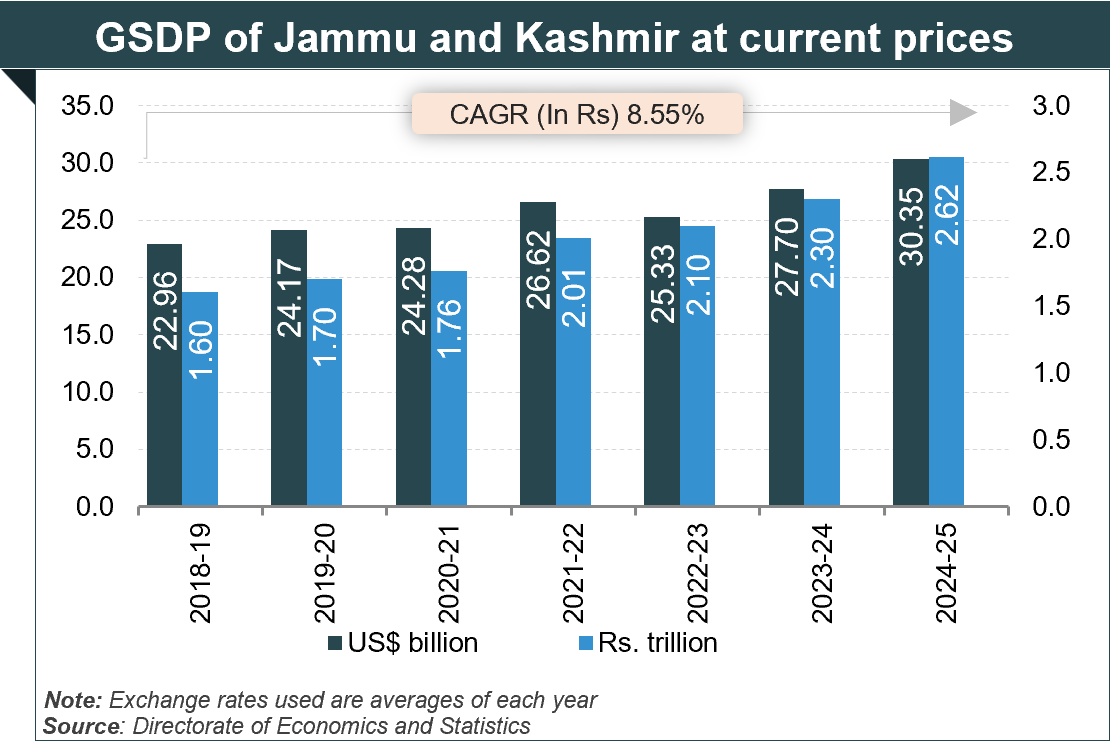
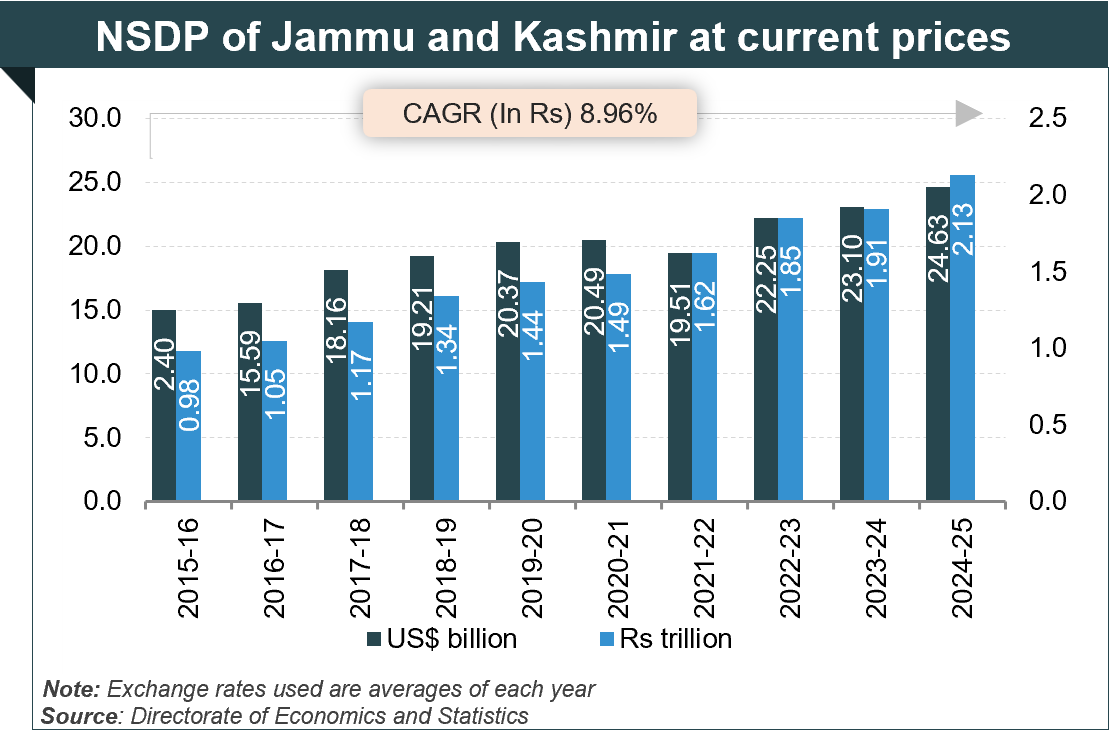
The economy is primarily services based and agri-oriented at current prices, J&K’s Gross State Domestic Product (GSDP) was Rs. 2.59 trillion (US$ 29.33 billion) in 2025-26. The UT’s GSDP increased at a CAGR of 7.08% between 2018-19 and 2025-26.
A vast natural resource base has enabled J&K to develop land for cultivating major fruits. With varied agro-climatic conditions, the scope for horticulture is significantly high in J&K. Food processing and an ideal climate for floriculture and an enormous assortment of flora and fauna. J&K has Asia’s largest tulip garden.
J&K’s handicrafts are world famous, and the traditional handicraft industry has emerged as a large industry. Due to its large employment base and export potential, the industry has been receiving priority attention of the government. The UT is also famous for its small-scale and cottage industries such as carpet weaving, silks, shawls, basketry, pottery, copper and silverware, papier-mâché, and walnut wood. The cottage handicrafts industry provides direct and gainful employment to around 340,000 artisans.
As of March 2026, J&K had a total installed power-generation capacity of 3479.45 MW, comprising 1917.23 MW under central utilities, 1372.9 MW (state/UT utilities) and 189.25 (private utilities). Jammu and Kashmir’s total installed power generation capacity stood at 3, 607.09 MW, comprising 2345.88 MW from hydropower, 706.22 MW from thermal power, 2678.10 MW from renewable sources, and 95.13 MW from nuclear power.
The significant increase in tourist arrivals in J&K over the last two years was noted. In 2025, Jammu & Kashmir recorded 1.78 crore tourist visits, following a record 2.36 crore tourist arrivals in 2024, reinforcing its position as one of India's leading tourism destinations. This surge in tourism in the UT was fuelled by remarkable growth following the removal of Article 370. In FY26, Rs. 390 crore (US$ 441.29 million) was allocated under the UT Capex Budget for tourism infrastructure development, with 611 projects, including works related to the Shri Amarnath Ji Yatra, already completed.
The following are some of the major initiatives taken by the Government to promote Jammu & Kashmir as an investment destination:
- Over the last seven years, 2,227 industrial units with investments of Rs. 15,940 crore (US$ 1.80 billion) became operational in Jammu & Kashmir, boosting the Union Territory's industrial base and investment activity.
- During FY26 (up to December 2025), Jammu & Kashmir attracted investments worth Rs. 5,260 crore (US$ 59.52 million), with 184 industrial units generating employment for 7,431 persons.
- As of FY26, Jammu & Kashmir's sericulture sector supported nearly 27,000 families and produced around 800 metric tonnes of bivoltine cocoons annually, contributing significantly to rural livelihoods and women's participation in economic activities.
- The government has placed a strong emphasis on highway development, particularly in regions such as Jammu and Kashmir, the northeastern states, and the hilly areas of Himachal Pradesh and Uttarakhand. Currently, road construction projects valued at Rs. 2,00,000 crore (US$ 23.31 billion) are in progress in Jammu and Kashmir, which includes the construction of 105 tunnels. Additionally, the government is undertaking the construction of the Zojila tunnel, recognized as Asia's longest tunnel designed for sub-zero temperatures, with an estimated investment of around Rs. 6,000 crore (US$ 699 million).
- In June 2025, the Centre approved a Rs. 4,224 crore (US$ 488.49 million) PMGSY-IV package for 316 rural road projects covering 1,781 km in Jammu and Kashmir.
- As of FY26, 29 projects with an outlay of Rs. 5,013 crore (US$ 567.24 million) were under implementation under the Holistic Agriculture Development Programme (HADP) to transform Jammu & Kashmir's agriculture sector over five years. The programme is projected to increase GSDP by around Rs. 28,000 crore (US$ 3.17 billion), create 2.88 lakh jobs and benefit nearly 13 lakh families.
- In FY26, 19 National Highway projects worth Rs. 10,637 crore (US$ 1.20 billion) were sanctioned, including the Pir Ki Gali Tunnel, Sadhna Tunnel, Lal Chowk-Parimpora Flyover and Magam Flyover, to improve regional connectivity and urban mobility
- In FY26, 19 National Highway projects worth Rs. 10,637 crore (US$ 1.20 billion) were sanctioned, including the Pir Ki Gali Tunnel, Sadhna Tunnel, Lal Chowk-Parimpora Flyover and Magam Flyover, to improve regional connectivity and urban mobility.
- In FY26, 19 National Highway projects worth Rs. 10,637 crore (US$ 1.20 billion) were sanctioned, including the Pir Ki Gali Tunnel, Sadhna Tunnel, Lal Chowk-Parimpora Flyover and Magam Flyover, to improve regional connectivity and urban mobility.
- Prime Minister Mr. Narendra Modi inaugurated, dedicated, and laid the foundation for numerous development projects worth over Rs. 46,000 crore (US$ 5.32 billion) in Jammu, spanning sectors like connectivity, aviation, healthcare, infrastructure, and petroleum.
- According to the Telecom Regulatory Authority of India, J&K had 13.27 million wireless and tele-density of 96.89%, as of March 2026.
- Between FY20 and FY25, over Rs. 5,400 crore (US$ 624.49 million) worth of road and infrastructure projects have been implemented or proposed across Jammu and Kashmir under NABARD and RIDF schemes.
- Union Minister for Road Transport & Highways, Mr. Nitin Gadkari allocated of Rs. 1404.94 crore (US$ 169 million) for the Widening and Strengthening project of the Rafiabad – Kupwara – Chowkibal – Tangdhar – Chamkot section of National Highway-701.
- According to the Department for Promotion of Industry and Internal Trade (DPIIT), cumulative FDI inflow in J&K was valued at Rs. 587 crore (US$ 77.31 million) between October 2019-March 2026.
- Under the State/UT Budget 2023-24, Rs. 2,928.04 crore (US$ 357.4 million) has been allocated for housing and urban development.
- As of FY26, Jammu & Kashmir's sericulture sector supported nearly 27,000 families and produced around 800 metric tonnes of bivoltine cocoons annually, contributing significantly to rural livelihoods and women's participation in economic activities.
- In FY26 (up to November 2025), 17 functional mandis linked to the National Agriculture Market (e-NAM) portal traded fruits and vegetables worth Rs. 634.09 crore (US$ 71.75 million), compared with Rs. 596.55 crore (US$ 67.50 million) in FY25.
- The Kashmir region is known for its horticulture industry. The industry plays a vital role in the UT’s economic development. In 2023-24, the total production of vegetables and fruits in the UT was estimated at 1,996.18 thousand metric tonnes and 2,643.24 thousand metric tonnes, respectively.
- J&K has an industrial policy that offers attractive incentives along with a single-window clearance mechanism. Land is allotted at concessional rates in industrial areas on lease for 90 years.
Note: P - Provisional, T - Target, MT - Million Tonnes, * Including Ladakh Union Territory
FACTFILE
Capital
Srinagar; Winter Capital - JammuGeographical Area (sq km)
222,236Union Territory Language
Urdu, Kashmiri, Dogri, Hindi, Pahari and LadakhiLiteracy Rate
68.7 per centKey Industries:
Horticulture
Floriculture
Handlooms and handicrafts
Tourism
Mineral-based industry
Gems and jewellery
Sericulture
IT
Pharmaceuticals
Related News
MOREPartners




