The Indian manufacturing sector is steadily emerging as a key pillar of the economy, contributing around 17% to GDP. The number of startups recognized increased by 51.6% year-on-year in FY 2025-26 compared to FY 2024-25, while direct jobs created rose by 36.1% during the same period. With government initiatives like Make in India and production-linked incentive (PLI) schemes. In FY2025-26, the Government launched the National Manufacturing Mission (NMM) to increase manufacturing's share in GDP to 25% by 2035, create 143 million jobs, and expand merchandise exports to Rs. 106.04 lakh crore (US$ 1.20 trillion) through deeper global value chain integration.
India’s manufacturing industry is also becoming increasingly process-driven and automated, with digital transformation improving efficiency, productivity, and competitiveness. The machine tool industry, once the backbone of manufacturing, is now supported by advanced technologies that encourage innovation and scale. As of 2026, India is one of the world’s fastest-growing electronics manufacturers, particularly in mobile phones. India has now achieved near self-reliance in mobile production, moving from importing most of its requirements a decade ago to manufacturing almost all devices domestically. The electronics manufacturing sector has generated around 25 lakh jobs in India over the last ten years.
Between FY2014-15 and FY2025-26, India's total exports increased from Rs. 41.36 lakh crore (US$ 468 billion) to a record Rs. 76.26 lakh crore (US$ 863 billion), registering a CAGR of 5.70%. Merchandise exports rose from Rs. 27.39 lakh crore (US$ 310 billion) to Rs. 39.06 lakh crore (US$ 442 billion), while services exports increased from Rs. 13.96 lakh crore (US$ 158 billion) to Rs. 37.20 lakh crore (US$ 421 billion), recording a CAGR of 9.30%. Engineering goods, electronic goods, pharmaceuticals, textiles, agricultural products, marine products, and gems and jewellery emerged as the key drivers of India's export growth.
The PMI moderated to [VP1.1]53.9 in March 2026, it recovered to 54.7 in April 2026 and further improved to 55.0 in May 2026, indicating sustained expansion in manufacturing activity driven by resilient demand, new orders and output.
India has achieved a record Rs. 76.00 lakh crore (US$ 860 billion) in total exports (goods and services) in 2025–26, surpassing approximately Rs. 69.76 lakh crore (US$ 825 billion) in 2024–25.
The cumulative exports (merchandise & services) during April-December 2025 are estimated at Rs. 56.05 lakh crore (US$ 634.26 billion), as compared to Rs. 53.74 lakh crore (US$ 607.93 billion) in April-December 2024, an estimated growth of 4.33%.
The cumulative value of merchandise exports during April-December 2025 was Rs. 29.18 lakh crore (US$ 330.29 billion), as compared to Rs. 28.49 lakh crore (US$ 322.41 billion) during April-December 2024, registering a positive growth of 2.44%.
The cumulative non-petroleum exports in April-December 2025 valued at Rs. 25.47 lakh crore (US$ 288.16 billion) registered an increase of 5.51% as compared to Rs. 24.13 lakh crore (US$ 273.12 billion) in April-December 2024.
Major drivers of merchandise exports growth in December 2025 include Electronic Goods, Meat, dairy & poultry products, Drugs & Pharmaceuticals, Engineering Goods and Marine Products.
Significant initiatives have been introduced under Aatmanirbhar Bharat and Make in India programmes to enhance India’s manufacturing capabilities and exports across the industries. Sector specific Production Linked incentives (PLI) have been introduced in the aftermath of the pandemic to incentivize domestic and foreign investments and to develop global champions in the manufacturing industry.
According to the NITI Aayog, India has the potential to significantly enhance its global manufacturing export share, supported by structural reforms and increasing integration into global value chains. India can potentially capture a larger global market share, targeting Rs. 2,13,925 crore (US$ 25 billion) in exports by 2035.
According to the Council for Leather Exports (CLE), India’s leather, non-leather footwear, and products exports increased by 25% at Rs. 48,667 crore (US$ 5.7 billion) in FY25, may hit Rs. 55,497 crore (US$ 6.5 billion) in FY26. In a renewed policy push, Mr. Narendra Modi has prioritised manufacturing across 15 sectors, including high-end semiconductors, metals and labour-intensive industries such as leather, with the objective of strengthening economic growth and boosting annual goods exports to US$ 1.3 trillion over the long term. Over the medium term, India aims to scale up its manufacturing output towards the US$ 1 trillion mark, reinforcing its position as a global manufacturing hub.
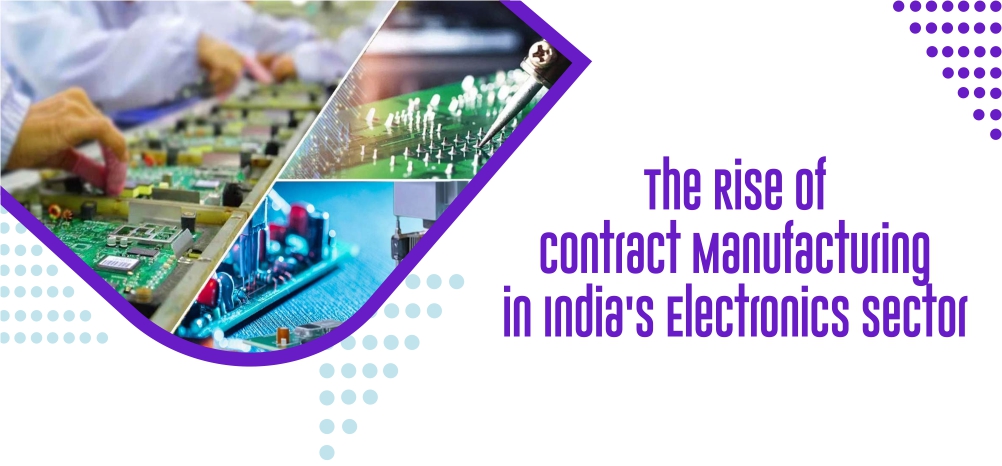
The Mobile Phone PLI scheme continued through 2025-26, and its impending completion in March 2026 will be another important milestone for the sector. Under this scheme, Indian mobile production scale has grown substantially, and we expect India to reach around Rs. 6.63 lakh crore (US$ 75.00 billion) in mobile production with more than Rs. 2.65 lakh crore (US$ 30.00 billion) in exports in FY26. Mobile phone production has grown fivefold in the past five years, positioning India as a global export hub. India Cellular and Electronics Association Chairman Pankaj Mohindroo told PTI that India delivered strong growth in electronics production, reaching Rs. 11.24 lakh crore (US$ 133.00 billion) in 2025, while exports continued to expand sharply. This growth is driving strong demand for integrated circuits and semiconductors, which will further accelerate as the industry shifts focus from assembly to full-scale hardware component manufacturing. PLI-led investments have encouraged smartphone production in India, making the country a major global mobile phone manufacturing hub.
India’s defence exports touched an all-time high of Rs. 38,424 crore (US$ 4.35 billion) in the financial year 2025–26, marking a sharp increase of Rs. 14,802 crore (US$ 1.67 billion) (62.66%) over the previous fiscal’s figure of Rs. 23,622 crore (US$ 2.79 billion). This is a nearly 25-fold increase from Rs 1,522 crore in 2016-17, highlighting a sharp expansion over the past decade. This growth has been driven by both Defence Public Sector Undertakings, which saw a 42.85% export increase, and a strong private sector contribution. The export trajectory shows a steady upward trend despite minor fluctuations. Defence exports crossed Rs. 10,000 crore (US$ 1.13 billion) for the first time in 2018-19, dipped slightly during the pandemic years, and then accelerated sharply from 2021-22 onwards. Between 2023-24 and 2025-26 alone, exports rose from Rs. 21,083 crore (US$ 2.49 billion) to Rs. 38,424 crore (US$ 4.35 billion), reflecting increased demand for Indian-made defence equipment and systems.
Building on the competitive advantage of a skilled workforce and lower cost of labour, the manufacturing sector is also witnessing an increased inflow of capex and heightened M&A activity, leading to a surge in manufacturing output and resultant increased contribution to exports. The positive developments in the manufacturing sector, driven by production capacity expansion, government policy support, heightened M&A activity, and PE/VC-led investment, are creating a robust pipeline for the country’s sustained economic growth in the years to come.
Real GDP or GDP at Constant Prices is estimated to attain a level of Rs. 188 lakh crore (US$ 2.15 trillion) in FY25, against the first revised estimate of GDP for the FY24 of Rs. 177 lakh crore (US$ 2.02 trillion), registering a growth rate of 6.5%.
The Nominal GDP, which counts inflation, is expected to grow by 8% in the current fiscal, against 9.7% last year. Real Gross Value Added (GVA) is expected to expand by 7.3% in FY26, up from 6.4% in FY25. In contrast, nominal GVA is projected to grow at 7.7% in the current fiscal, lower than the 9.3% growth in the previous financial year.
The Nominal GVA is estimated to attain a level of Rs. 323.48 lakh crore (US$ 3.66 trillion) during FY 2025-26, against Rs. 300.22 lakh crore (US$ 3.55 trillion) in FY 2024-25, showing a growth rate of 7.7%.
Capacity utilisation in the manufacturing sector is measured by Reserve Bank of India (RBI) in its quarterly order books, inventories and capacity utilisation survey. It indicates not only the production levels of companies but also the potential for future investment.
In FY2025-26, capacity utilisation in the manufacturing sector, as measured by the Reserve Bank of India's Order Books, Inventories and Capacity Utilisation Survey (OBICUS), increased from 74.10% in Q1 to 74.30% in Q2 and further to 75.60% in Q3, indicating sustained improvement in manufacturing activity and production capacity utilisation.
The Index of Industrial Production (IIP), compiled by the Ministry of Statistics and Programme Implementation, measures industrial activity across mining, manufacturing and electricity, with manufacturing accounting for 77.63% of the index (base year 2011–12). The Index of Industrial production rose by 7.8%, reaching its highest level in over 2 years, after registering a high growth of 7.2%(RE) in November 2025.
Growth in IIP in December 2025, is driven by across-the-board surge in Manufacturing (8.1%), mining (6.8%) and electricity (6.3%). In Manufacturing, highest growth recording industries are “computer, electronic and optical products (34.9%)”, “motor vehicles, trailers and semi-trailers (33.5%)” and “other transport equipment (25.1%)”.
The Madhya Pradesh government has introduced the Drone Promotion and Utilisation Policy 2025, aiming to boost drone manufacturing and its application across various sectors. The policy offers incentives, of a 40% capital investment subsidy, up to Rs. 30 crore (US$ 3.4 million) for new investments, and a 25% subsidy on lease rents for three years.
India is planning to offer incentives of up to Rs. 18,000 crore (US$ 2.03 billion) to spur local manufacturing in six new sectors including chemicals, shipping containers, and inputs for vaccines.
This mission was announced by the Union Minister for Finance and Corporate Affairs, Ms. Nirmala Sitharaman in the Union Budget 2025-26 to boost "Make in India" by supporting industries of all sizes with policy frameworks, ease of business, MSME growth, future-ready workforce, and clean tech manufacturing.
The mission places emphasis on five key areas: ease and cost of doing business, developing a future-ready workforce for in-demand jobs, a vibrant MSME sector, availability of technology, and quality products. It also aims to boost domestic value addition and build ecosystems for clean tech manufacturing such as solar PV cells, EV batteries, electrolyzers, wind turbines, and grid-scale batteries.
The Union Minister of Finance, Ms. Nirmala Sitharaman, in the Union Budget 2025–26 (February 2025) announced a focus product scheme aimed at enhancing the productivity, quality and competitiveness of India’s footwear and leather sector. The scheme will support design capabilities, component manufacturing and machinery required for producing non-leather footwear as well as leather products. The scheme is expected to generate employment for 22 lakh people, achieve a turnover of Rs. 4 lakh crore (US$ 45.66 billion) and facilitate exports exceeding Rs. 1.1 lakh crore (US$ 12.56 billion).
According to the Ministry of Electronics and Information Technology report titled ‘Estimation and Measurement of India’s Digital Economy’ (2025), India’s digital economy is projected to grow almost twice as fast as the overall economy, contributing nearly 20% of national income by 2029–30, up from 11.74% in 2022–23. The digital economy is expected to surpass both agriculture and manufacturing in economic contribution, driven by the expansion of digital platforms and widespread digitalisation across sectors.
The Union Minister of Defence Mr. Rajnath Singh emphasized that the path to ‘Aatmanirbhar Bharat’ is a comprehensive set of policy frameworks that seeks to build indigenous technological and production capacity & capability with cooperation, participation and collaborations with reputed institutions and Original Equipment Manufacturers (OEMs) from friendly nations.
The Defence Acquisition Council, chaired by Union Minister of Defence Mr. Rajnath Singh, has approved Rs. 67,000 crore (US$ 7.65 billion) worth of projects to strengthen the Indian Army, Navy, and Air Force. The move focuses on boosting ‘Make in India’ with key roles for Hindustan Aeronautics Limited (HAL), Bharat Electronics Limited (BEL), and Bharat Dynamics Limited (BDL).
Under the "Make in India" initiative, the Marhowrah Diesel Locomotive Factory in Bihar is set to export 150 Evolution Series ES43ACmi locomotives to Guinea for its Simandou iron ore project. Developed in partnership with Wabtec, this export deal is valued at over Rs. 3,000 crore (US$ 0.34 billion) and significantly expands India’s global footprint in railway manufacturing.
These six platforms will work towards urging industries (including Original Equipment Manufacturers (OEMs) Tier-I, Tier-II, and Tier-III companies and raw material manufacturers), start-ups, domain experts/professionals, R&D institutions, and academia (college and universities) to come up with technology solutions, suggestions and opinions on matters related to manufacturing technologies.
India has potential to become a global manufacturing hub and by 2030, it can add more than Rs. 44.19 lakh crore (US$ 500.00 billion) annually to the global economy.¬
Global companies like Apple are expanding manufacturing in India. In FY26, iPhone exports from India reached a record Rs. 2 lakh crore (US$ 22.63 billion), making iPhones the country's largest branded export. They accounted for over 75% of India's smartphone exports, highlighting the success of the Production Linked Incentive (PLI) Scheme and India's emergence as a global electronics manufacturing hub.
In FY2025-26, the Government strengthened India's manufacturing ecosystem by approving the Electronics Components Manufacturing Scheme (ECMS) with an outlay of Rs. 22,919 crore (US$ 2.59 billion).
In March 2026, the Government promoted global collaborations in aerospace manufacturing, highlighting joint ventures with international companies such as Embraer and Sukhoi to establish manufacturing facilities and strengthen India's aerospace production capabilities.
According to the White & Case, India ranked eight among the top recipients of Foreign Direct Investment (FDI) in the world in 2023. 100% FDI is approved in the sector through automatic route under the current FDI Policy. In FY2025-26, India's gross Foreign Direct Investment (FDI) inflows reached a record Rs. 8,35,070.61 crore (US$ 94.53 billion), registering 17% year-on-year growth.
The Government of India continues to strengthen manufacturing through the Production Linked Incentive (PLI) Scheme, with an outlay of Rs. 1.91 lakh crore (US$ 21.61 billion), covering 14 strategic sectors and attracting strong industry participation.
The manufacturing sector has seen some major developments, investments, and support from the Government in the recent past.
- In FY2025-26, smartphone manufacturing under the Production Linked Incentive (PLI) Scheme surpassed its targets, with cumulative production reaching Rs. 6.66 lakh crore (US$ 75.36 billion) against the FY2024 target of Rs. 4.39 lakh crore (US$ 49.68 billion). Cumulative investments also increased to Rs. 9,100 crore (US$ 1.03 billion), exceeding the scheme's FY2026 target of Rs. 7,000 crore (US$ 0.79 billion), reinforcing the Government's Make in India and Aatmanirbhar Bharat initiatives.
- The Indian government, led by Union Minister of Commerce & Industry, Mr. Piyush Goyal, is launching a new scheme to energize the country's toy sector. The initiative aims to improve several key areas: strengthening toy design, boosting manufacturing quality, enhancing packaging standards, and supporting brand-building efforts.
- The Union Minister of Commerce and Industry, Mr. Piyush Goyal, highlighted significant progress in domestic manufacturing. Notably, around 99% of mobile phones sold in India are now manufactured domestically, supported by strong policy incentives and rising Foreign Direct Investment (FDI).
- India’s Global Capability Centres (GCCs) sector is expanding rapidly, with over 1,700–1,800 centres operational across the country as of 2024–25. In FY24, GCCs generated export revenue of approximately Rs. 5,34,759 crore (US$ 64.6 billion). Industry estimates suggest that exports may have crossed Rs. 6,76,484 crore (US$ 80 billion) in FY25, reflecting continued strong growth.
- India is expected to remain a global hub for GCCs, with the total number of centres projected to reach around 2,400–2,500 by 2030, driving innovation, job creation and economic value creation.
- Global Capability Centres in India are estimated to create around 4.25–4.50 lakh new jobs in 2025 alone, with the total workforce reaching approximately 2.4 million professionals in 2025–26. The sector is projected to employ 2.8–3.5 million professionals by 2030.
- India’s GCCs witnessed an 8–10% increase in hiring volumes in Q1 FY26, compared with a 3–6% decline in Q4 FY25. The manufacturing, automotive and energy sectors recorded the highest demand growth at 31% quarter-on-quarter, driven by increased investments in smart factories, Industrial Internet of Things (IIoT) and electric vehicle (EV) platforms.
- In May 2025, the Employees' Provident Fund Organisation (EPFO) added a net total of 20.06 lakh members, the highest recorded addition since April 2018, registering a 2.84% year-on-year growth. Of this, 9.42 lakh were new members, largely driven by increased employment opportunities and effective outreach initiatives. The 18–25 age group accounted for 59.48% of total new subscribers, with 5.60 lakh additions. Female participation also increased, with 2.62 lakh new female subscribers, reflecting a 5.84% year-on-year growth compared with May 2024.
- Prime Minister Mr. Narendra Modi announced an Employment Linked Incentive Scheme with an Rs. 1,00,000 crore (US$ 11.62 billion) outlay to support first-time private sector employees, expected to generate 3.5 crore jobs.
In the Union Budget 2026-2027 the government is estimated to spend Rs. 53,47,315 crore (US$ 605.06 billion) in FY27, 7.7% higher than the revised estimate of 2025-26. Interest payments account for 26% of the total expenditure, and 40% of revenue receipts.
While global manufacturing output expanded modestly by 0.7% in the third quarter of calendar year 2025, India recorded manufacturing output growth of 1.3% during the same period. This performance reflects the strength of domestic fundamentals and sustained policy support for industrial expansion.
Manufacturing today sits as the engine of growth for India’s ambition to become a Rs. 3,093.13 lakh crore (US$ 35.00 trillion) economy by 2047, with reforms, sectoral initiatives, and resilient supply chains. Recognising this importance, the Union Budget 2026-27 has reinforced support for manufacturing through targeted measures focusing on investment incentives, innovation, infrastructure development, and industrial ecosystem strengthening.
Building on the three defined Kartavyas, the manufacturing sector is poised to drive India’s growth, employment generation, export competitiveness, and long-term economic transformation.
Forward-looking indicators continue to reflect optimism in India’s industrial sector, with the manufacturing Purchasing Managers’ Index (PMI) remaining firmly in expansion zone (well above the 50 mark) since March 2023. In January 2026, PMI stood at 55.4, above its long-run average, indicating continued improvement in the sector’s health.
The Economic Survey 2025-26 highlights that medium- and high-technology industries now contribute 46.3% of India’s manufacturing value added, signalling a gradual shift towards more sophisticated production structure.
Micro, Small and Medium Enterprises (MSMEs) remain central to India’s industrial economy, contributing about 35.4% of manufacturing output, 48.58% of exports, and 31.1% of GDP, while employing over 32.82 crore people across 7.47 crore enterprises, making them the second-largest employer after agriculture.
As India’s manufacturing integrates further with global markets, MSMEs play a vital role in strengthening supply chains, promoting local value addition, and supporting inclusive regional development.
To strengthen innovation financing, the Government announced a Research, Development and Innovation (RDI) Fund with a Rs. 1 lakh crore (US$ 11.32 billion) outlay over six years, including Rs. 20,000 crore (US$ 2.26 billion) for FY26.
To capitalise on the momentum of investment commitments beyond set targets and to accelerate domestic component manufacturing, outlay increased from Rs. 22,919 crore (US$ 2.59 billion) to Rs. 40,000 crore (US$ 4.53 billion.
India’s electronic manufacturing strategy is driven by the Prime Minister’s vision of AtmaNirbhar Bharat and Making India a global manufacturing hub. The Government adopted a structured and targeted policy for electronics manufacturing across the entire value chain including semiconductors. The Government of India has approved 10 semiconductor manufacturing projects with investment commitments of about Rs. 1.60 lakh crore (US$ 18.11 billion), with commercial production already commencing at select plants. Additional units are expected to become operational in 2026, strengthening India’s semiconductor ecosystem and domestic manufacturing capabilities.
The 'Operation Green' scheme of the Ministry of the Food Processing Industry, which was limited to onions, potatoes, and tomatoes, has bcapaeen expanded to 22 perishable products to encourage exports from the agricultural sector. This will facilitate infrastructure projects for horticulture products.
India’s manufacturing sector is on a strong growth trajectory, powered by policy support, rising investments, expanding exports, and increasing technological adoption. With its skilled workforce, robust infrastructure, and global competitiveness, India is steadily transforming into a leading manufacturing hub. Looking ahead, the sector is poised to play a central role in driving economic growth, innovation, and employment, positioning the country as a key player in global value chains.