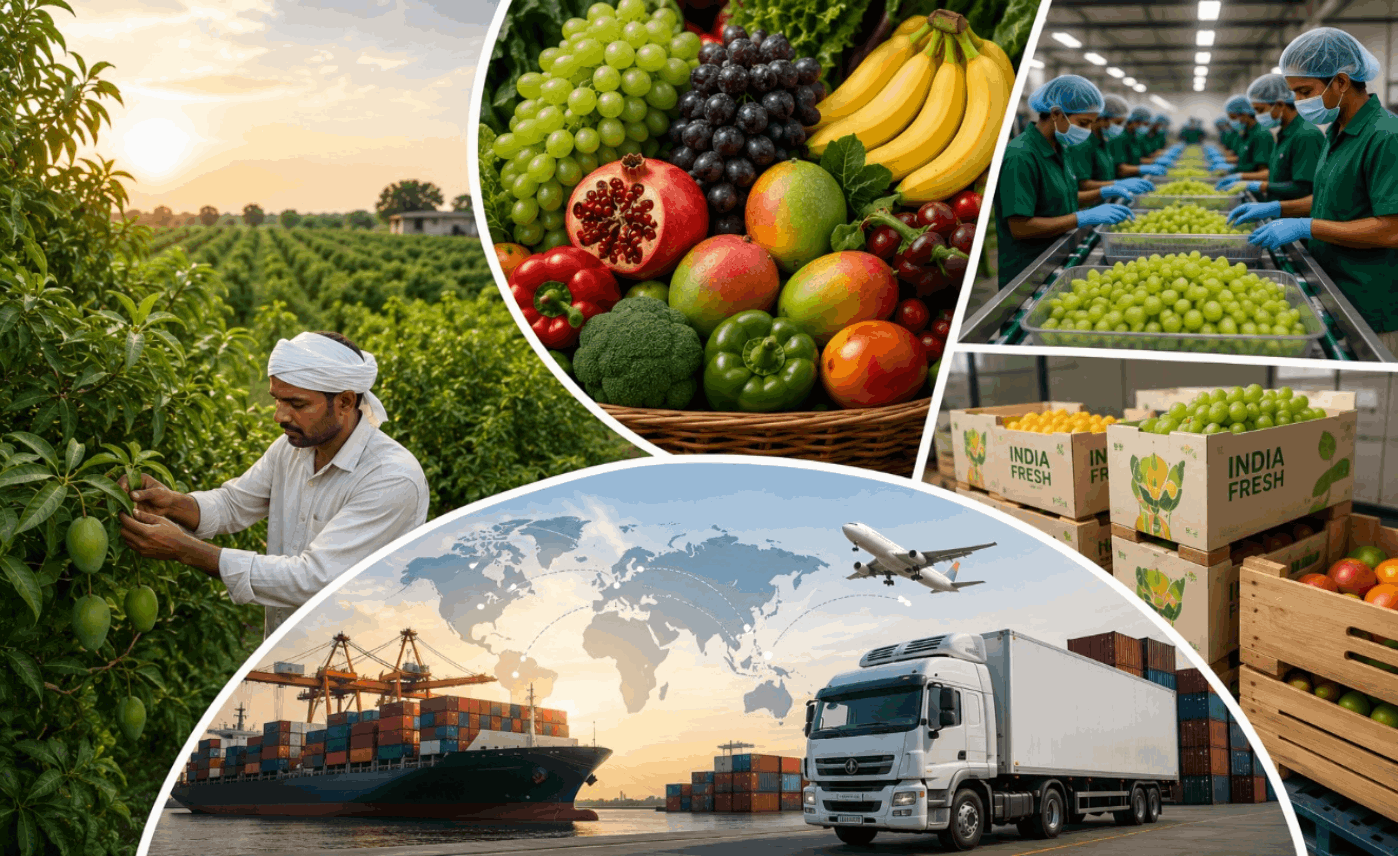
India is the fourth-largest economy in the world and is expected to remain the fastest-growing major G20 economy, with GDP growth projected at around 6.8%–7.2% in FY27. The food processing sector has emerged as one of the key contributors to this growth, supported by progressive policies of the Ministry of Food Processing Industries (MoFPI). Indian food processing market size reached Rs. 33,052.5 billion (US$ 382.24 billion) in FY25 and is expected to reach Rs. 65,835 billion (US$ 689.02 billion) by FY34.
Exports remain a strong driver of the sector. In FY26, processed fruits and vegetables exports stood at Rs. 25,987.41 crore (US$ 2,940.75 million), animal products at Rs. 55,114.51 crore (US$ 6,236.79 million), and other processed foods at Rs. 45,014.71 crore (US$ 5,093.89 million). The Grand total export of floriculture, fresh fruits & vegetables, processed fruits and vegetables, animal products, other processed foods, cereals, and cashew stood at Rs. 2,55,124.19 crore (US$ 28.87 billion) in FY26.
The sector has also been attracting steady foreign investment. From January 2000 to March 2026, India’s food processing industry has received cumulative FDI inflows of approximately Rs. 1,13,107.85 crore (US$ 16.15 billion), aided by favourable policies, tax benefits, and government schemes. Initiatives like the Production Linked Incentive Scheme for Food Processing Industry (PLISFPI), with an outlay of Rs. 10,900 crore (US$ 1.3 billion), and the PLI scheme for Millet-Based Products (PLISMBP), launched in FY23 with Rs. 800 crore (US$ 96 million) are expected to further accelerate growth and global competitiveness.
Infrastructure support has been another key focus. In 2026, MoFPI had approved 41 Mega Food Parks, 401 Cold Chain projects, 76 Agro-processing Clusters, and 588 Food Processing Units under PMKSY schemes. As of FY26, 408 integrated cold chain projects were taken up, of which 300 were completed, creating 10.06 lakh MT of cold storage, 331 MT/hour of quick-freezing capacity, 190.98 Lakh Liters Per Day (LLPD) of milk processing/storage, and 1,924 reefer vehicles.
The industry also benefits from India’s vast agricultural base. Diverse agro-climatic conditions provide a strong raw material supply for sub-sectors such as fruits and vegetables, poultry and meat, dairy, fisheries, grains, spices, nutraceuticals, and ready-to-eat segments. In 2025-26, horticulture production at 3708.46 lakh tonnes reflects government investments under Prime Minister Narendra Modi in technology, irrigation, value chains, processing, storage, cold chains and markets yielding ground-level results, advancing farmer incomes and profitable, sustainable agriculture, making India the second-largest producer of fruits and vegetables. India remains the world's largest producer, consumer, and exporter of spices. During 2025-26, India exported 17.34 lakh tons of spices and spice products valued at Rs. 39,140.11 crore (US$ 4,430.90 million) as compared to 17.99 lakh tons valued at Rs. 39,994.48 crore (US$ 4,722.65 million) during 2024- 25, registering a decline of 4% in volume, 2% in rupee terms of value and 6% in dollar terms of value. During 2025-26, the major contributors in spice export basket in terms of value were Chilli (27%), Cumin (12%), Spice oil & Oleoresins (12%), Small Cardamom (9%), Mint products (8%), Turmeric (7%), Curry powder/paste (6%), Ginger and Pepper (3%) and Coriander(2%), which together contributed to more than 90% to the total export earnings from spices.
India ranks first in milk production, contributing around 25% of global milk production. India’s milk production is projected to rise 6% to 263 million tonnes in FY27 from 248 million tonnes in FY26. Milk production is growing at Compound Annual Growth Rate (CAGR) of 5.41% over the past 11 years from 146.31 million tonnes during 2014-15 to 247.87 million tonnes during 2024-25. Egg production in the country has increased from 78.48 billion in 2014-15 to 149.11 billion Nos. in 2024-25. From FY15, egg production grew at a rate of 6.63% CAGR to FY25, while Meat production grew at 4.61% CAGR in the same period, ranking India second in eggs and fourth in meat globally production.
India’s food and grocery market is one of the largest globally, supported by a retail market exceeding Rs. 95,117 trillion (US$ 1.1 trillion) in 2025, with food and grocery accounting for ~60–70% of total retail consumption. The Indian food processing industry accounts for 32% of the country's total food market, one of the largest industries in India, and is ranked fifth in terms of production, consumption, export, and expected growth. It employs nearly 1.93 million people in the registered sector and another 5.1 million in the unregistered segment.
Overall, the food processing sector has been growing at an average annual rate of 5.35% in recent years. Supported by a planned Rs. 95,704.90 billion (US$ 1 trillion) infrastructure push and Rs. 25 lakh crore (US$ 300 billion) investment into the rural economy, the sector is well-positioned to remain one of the strongest pillars of India’s economic growth.
The food processing sector has seen some major developments, investments, and support from the Government in the recent past.
- The Animal Husbandry Infrastructure Development Fund (AHIDF) promotes private investment in animal husbandry infrastructure through a total outlay of Rs. 29,610.25 crore (approximately US$ 3.5 billion) and provides a 3% interest subvention. As of December 2025, 428 projects had been approved, with loans sanctioned amounting to Rs. 10,320 crore (US$ 1.19 billion) and interest subvention of Rs. 429.49 crore (US$ 49.67 million) released.
- The Union Budget FY26 allocated Rs. 2,000 crore (US$ 226.31 million) to the PM Formalisation of Micro Food Processing Enterprises (PMFME) scheme, strengthening micro food processing units and rural value chains.
- Government of India has allocated budget estimates of Rs. 4,064 crore (US$ 459.88 million) to the Ministry for the development of the Food Processing Sector in FY27, which marks an increase of about 13.79 % from the revised estimate of Rs. 3,571.57 Crore (US$ 404.14 million) in FY26.
- The Production Linked Incentive Scheme for Food Processing Industries (PLISFPI) has approved 169 applications as of February 2026, resulting in investments exceeding Rs. 9,207 crore (US$ 1.04 billion). The scheme has created around 35 lakh MT per annum of processing capacity and generated about 3.39 lakh direct and indirect jobs, while exports of PLI-supported products has increased with a CAGR of 13.23% as on 2024-25 with reference to 2019- 20.
- India is boosting turmeric exports via the SPICED scheme, which includes quality certification, value-addition support, post-harvest upgrades, and domestic & international market linkage programs under the newly formed National Turmeric Board.
- APEDA has launched the BHARATI (Bharat's Hub for Agritech, Resilience, Advancement, and Incubation for Export Enablement) initiative to empower 100 agri-food and agri-tech startups, foster innovation, improve export readiness and help India achieve Rs. 4,28,450 crore (US$ 50 billion) in agri-food exports of its scheduled products by 2030.
- In a major boost to the dairy industry, India’s iconic dairy brand, Amul has announced setting up the world’s largest curd (dahi) manufacturing facility in Kolkata. This new integrated dairy plant, backed by Rs. 600 crore (US$ 69.1 million) investment will significantly expand Amul’s footprint in West Bengal.
- The Ministry of Food Processing Industries (MoFPI) has been allocated Rs. 4,064 crore (US$ 459.86 million) in the Union Budget 2026–27, reflecting continued government focus on strengthening the food processing ecosystem.
- In July 2025, the Union Cabinet approved an additional outlay of Rs. 1,920 crore (approximately US$ 219 million), increasing the total allocation under the Pradhan Mantri Kisan SAMPADA Yojana (PMKSY) to Rs. 6,520 crore (US$ 745 million) for the Fifteenth Finance Commission (2021–22 to 2025–26), valid until 31 March 2026. The approval includes Rs. 1,000 crore (US$ 114 million) to support the establishment of 50 Multi-Product Food Irradiation Units under the Integrated Cold Chain and Value Addition Infrastructure (ICCVAI) component, along with 100 NABL-accredited Food Testing Laboratories under the Food Safety and Quality Assurance Infrastructure (FSQAI) component.
Gross Value Added (GVA) in India’s food processing sector has increased from Rs. 1.61 lakh crore (US$ 24.60 billion) in 2015–16 to Rs. 2.24 lakh crore (US$ 27.06 billion) in 2023–24 (first revised estimates of the Ministry of Statistics and Programme Implementation).
As of FY26, 408 integrated cold chain projects have been taken up for implementation. Out of these 408 projects, 300 projects have been completed, and 108 are at various stages of implementation.
The Production Linked Incentive Scheme for Food Processing Industry (PLISFPI) had 169 applications approved as of February 2026, leading to an increase in food processing capacity of around 35 lakh MT per annum, generating about 3.39 lakh direct and indirect jobs, and boosting exports of processed food products with a 13.23% CAGR (2024–25 over 2019–20).
As of FY2025–26 (31 March 2026), 408 integrated cold chain projects had been approved under the Pradhan Mantri Kisan SAMPADA Yojana (PMKSY).Out of these 408 projects, 300 projects have been completed and 108 are at various stages of implementation. The capacity expected to be created by the approved cold chain projects is as follows: 10.06 lakh MTof Cold Storage, Controlled Atmosphere (CA)/Modified Atmosphere (MA) Storage and Deep Freezer, 331 MT per hour of Individual Quick Freezing (IQF), 190.98 Lakh Liters Per Day (LLPD) Milk Processing/Storage and 1924 reefer vehicles.
The Mega Food Park (MFP) Scheme was launched to integrate agricultural production with the market by bringing together farmers, processors, and retailers. The scheme follows a cluster approach, establishing modern food processing units within well-defined agri/horticultural zones.
Each park includes supply chain infrastructure like collection centres, processing units, and cold chains, along with developed plots for entrepreneurs. Under the MFP scheme, 41 projects were approved, of which 25 are operational as of FY2026.
The PM Formalisation of Micro Food Processing Enterprises (PMFME) Scheme had supported the formalisation of over 59,200 micro food processing enterprises by December 2025, mobilising investments exceeding Rs. 17,000 crore (US$ 2.01 billion) generating more than 5.18 lakh employment opportunities.
The Ministry of Food Processing Industries continued inviting proposals under the Integrated Cold Chain and Value Addition Infrastructure Scheme, including establishment of multiproduct food irradiation units to reduce post-harvest losses and improve food safety.
The Ministry of Food Processing Industries continued expanding institutional support through NIFTEM and sector-specific capacity-building initiatives to strengthen innovation, entrepreneurship and skilled manpower for India's food processing industry.
The Indian food processing sector offers a promising growth journey ahead and presents several opportunities with the sector being recognised as a key priority industry under the “Make in India” initiative. The MoFPI has undertaken several initiatives aimed at enhancing infrastructure and fostering food processing industries to stimulate investment in this domain. The Indian Government has sought to involve multiple stakeholders to improve interactions between farmers, processors, distributors, and retailers to establish strong supply chains linking farmers to processing and marketing to empower them with nearby grading and storage facilities which will enhance the value of their products.
There are substantial investment prospects totalling Rs. 225.79 billion (US$ 2.36 billion) across 31 projects under Common Infrastructure for Industrial Parks which includes facilities such as specialized processing units, effluent treatment plants, testing laboratories, common warehouses, and logistics support. These facilities are designed to support the industry's manufacturing processes and ensure compliance with environmental regulations while promoting efficient production and export capabilities.
As of 10 April 2023, India's food processing sector had over 3,300 DPIIT-recognized startups spread across 425 districts, employing approximately 33,000 people. The startup ecosystem continues to be supported through government initiatives such as the Startup India Seed Fund Scheme (SISFS), eligible Startup India tax incentives, incubators, accelerators, and innovation support programmes, fostering entrepreneurship and technological innovation across the food processing value chain.
India’s food processing sector stands as a vital pillar of the nation’s growth journey, supported by robust government initiatives, expanding infrastructure, and rising global demand. With strong export momentum, increasing foreign investments, and growing startup participation, the industry is poised to unlock immense value across the agri-food value chain. Continued focus on innovation, sustainability, and inclusive rural development will further enhance its global competitiveness. Looking ahead, the sector is well-positioned to strengthen India’s role as a global hub for high-quality, value-added food products, driving employment, empowering farmers, and contributing significantly to the vision of a developed India by 2047.
References: Ministry of Food Processing Industries (MoFPI), Press Information Bureau, Nivesh Bandhu Investor Portal, Source: Agricultural & Processed Food Products Export Development Authority (APEDA), News Articles, Department for Promotion of Industry, and Internal Trade (DPIIT), Union Budget 2025-26, Union Budget 2023-24, Interim Budget 2024-25, Grant Thornton - Viksit Bharat by 2047: Role of the food processing sector, India Investment Grid, Startup India.