India’s FMCG sector has expanded strongly, driven by consumer-led demand and rising product prices, particularly for essentials. The market stood at Rs. 25,000 billion (US$ 289.12 billion) in 2025 and is projected to reach Rs. 61,487.20 billion (US$ 642.87 billion) by 2030. GST rationalisation is expected to make daily essentials and FMCG products more affordable, boosting consumption while supporting the growth of e-commerce and quick-commerce channels. India has 1,092.79 million internet subscribers at the end of March 2026, with rural penetration accounting for 46 per 100 people, and Indians collectively spent 1.1 lakh crore hours on smartphones in 2024, averaging five hours daily per person. These shifts are reshaping how consumers discover, purchase, and interact with FMCG brands.
The Government e-Marketplace (GeM) has achieved a cumulative Gross Merchandise Value (GMV) of Rs. 18.4 lakh crore (US$ 208.2 billion), including crossing Rs. 5 lakh crore (US$ 56.6 billion) GMV in FY2025–26. The platform continues to evolve as a transparent, efficient, and inclusive digital public procurement system, contributing to strengthening India’s public economy.
Exports and domestic consumption are increasingly supported by new business models. India's direct selling industry continued its steady growth trajectory, achieving an all-time high turnover of Rs. 23,021 crore (US$ 2.66 billion) in FY25, registering a 4% year-on-year growth (in Rs. terms), according to the Indian Direct Selling Association (IDSA) in its Direct Selling Industry 2025 Outlook. The number of active direct sellers in India increased to 93.2 lakh in FY 2024–25, with female participation rising to 48% from 44% in the previous fiscal year. Meanwhile, India’s D2C market, valued at Rs. 6,96,400 crore (US$ 80 billion) in 2024, is expected to exceed Rs. 8,70,500 crore (US$ 100 billion) in 2025. Competition in this space is intensifying, FMCG product launches rose 1.8 times by May 2025, though only 4% crossed 1% market penetration. Leading companies have expanded portfolios through acquisitions: Marico entered a strategic deal with PVR INOX to acquire its 4700BC premium snacks brand for Rs. 226.8 crore (US$ 25.77 million), expanding its FMCG portfolio and strengthening its presence in packaged snacking.
Around two‑thirds of acquisitions by FMCG firms from FY21 to FY25 have been in the direct‑to‑consumer (D2C) space, per Crisil Ratings.
Quick commerce has emerged as a game-changer, transforming the grocery segment. The quick commerce market in India currently exhibits a penetration rate of only 7% of the potential market, with a total addressable market of Rs. 4,305.03 billion (US$ 45 billion), surpassing that of food delivery, indicating that a significant opportunity remains untapped. It now accounts for 70-75% of e-grocery orders, up from 35% in 2022, with growth at a 70-80% CAGR, making India the world’s first scaled quick-commerce market across 80 cities. FMCG companies reported a 50-100% jump in sales via this channel in FY25, supported by wider assortments, rising incomes, and consumer demand for convenience.
India's online retail market reached approximately Rs. 7,069 billion (US$ 80 billion) in FY26, registering 21% year-on-year growth, driven by rapid expansion of Quick Commerce, Value Commerce, and increasing digital adoption across Tier II and Tier III cities. India had nearly 290–300 million online shoppers in 2025, with Tier-2+ cities contributing around 65% of incremental shoppers. Shopper penetration remains only 25–30% of internet users in smaller cities, leaving significant room for future growth.
Performance momentum has been strong into FY26. In Q1 FY26, Dabur projected single-digit revenue growth, Nykaa’s beauty vertical saw mid-20% GMV growth, Trent expanded 20%, and Kalyan Jewellers rose 31%, aided by urban recovery and easing inflation. According to NielsenIQ, India's FMCG sector recorded 12.9% value growth and 5.4% volume growth in Q2 FY26, with rural volumes growing 7.7%, outpacing urban markets, driven by stronger consumption and improving economic conditions.
As per NielsenIQ, India’s FMCG sector posted steady momentum in the Q2 FY26 with value growth of 12.9% and a 5.4% rise in volumes, supported by stronger rural demand with 7.7% volume expansion. India’s FMCG sector witnessed a clear demand shift in 2025, with overall volume growth moderating to 4.1% (down from 4.7% in 2024), primarily due to a sharp rural slowdown, where growth declined to 3.6% from 5%, while urban markets showed relative resilience with a marginal uptick to 4.6% from 4.5%, indicating a structural rebalancing of consumption trends and highlighting urban recovery as a key stabilizing force amid weakening rural momentum. Diwali boosted FMCG sales, with essentials, dairy, oils, and snacks seeing strong demand and e‑commerce orders rising over 85% in the first week festive season sale.
Advertising remains a key lever. India’s FMCG sector remained the largest advertiser in 2024, contributing around 34% of total ad expenditure, with spends estimated at Rs. 31,428 crore (US$ 3.57 billion), maintaining its dominant share in the advertising market. On digital platforms, FMCG brands contributed 42% of total spends, with digital advertising growing to Rs. 86,184 crore (US$ 9.92 billion) in 2023.
The sector’s growth is further anchored by the food processing industry, which accounts for 32% of the country’s total food market, one of the largest industries in India and is ranked fifth in terms of production, consumption, export and expected growth. Indian food processing market size reached Rs. 33052.5 billion (US$ 382.24 billion) in FY25 and is expected to reach Rs. 65,835 billion (US$ 689.02 billion) by FY34. From April 2000 to March 2026, India’s food processing industry has received cumulative FDI inflows of approximately Rs. 1,13,107.85 crore (US$ 16.15 billion), reflecting steady growth in foreign investment in the sector. India’s PLI schemes, with Rs. 1.91 lakh crore (US$ 21.70 billion) total outlay have driven over Rs. 2.16 lakh crore (US$ 24.55 billion) investments and significant production growth, strengthening manufacturing, including food processing and FMCG supply chains. In Union Budget 2026, the government continued strengthening PLI schemes, proposing Rs. 40,000 crore (US$ 4.55 billion) allocation for electronics and considering expansion into emerging sectors like AI and advanced manufacturing. Also, the Production Linked Incentive Scheme for Food Processing (PLISFPI), with a budget of Rs. 10,900 crore (US$ 1.3 billion), has approved 278 units, creating 3.4 lakh jobs, adding 35 lakh MT of capacity, and attracting Rs. 9,032 crore (US$ 1.04 billion) in investments. Sales generated under the scheme reached Rs. 3,80,000 crore (US$ 43.95 billion) till March 2025, with incentives of Rs. 1,727 crore (US$ 180.5 million) disbursed. The scheme has also boosted farmer incomes through higher raw material procurement and strengthened India’s global brand presence by reimbursing up to 50% of overseas marketing and branding costs.
In May 2026, Tata Consumer Products expanded its FMCG portfolio by entering the ready-to-drink (RTD) energy beverage segment through innovation-led product launches, strengthening its presence in high-growth functional beverage categories and targeting younger consumers.
In May 2026, Tata Consumer Products strengthened its product portfolio by expanding its health and wellness categories, with Organic India and Tata Sampann recording 33% year-on-year growth, reinforcing the company's focus on premium nutrition and functional foods.
During March–May 2026, ITC expanded its FMCG portfolio with new product launches across Aashirvaad, Sunfeast, Bingo!, YiPPee!, Fiama, Savlon, Mangaldeep, Engage, and Classmate, with a strategic focus on premiumisation, health & wellness, and convenience-driven categories.
In May 2026, several Indian D2C brands revised their packaging strategies in response to rising raw material costs linked to the West Asia conflict. Companies such as Boba Bhai and Lahori Zeera introduced cost-efficient packaging formats to protect margins while maintaining affordability and product availability.
In March 2026, ITC expanded its nutrition-focused portfolio with the launch of Aashirvaad Iron Shakti Salt, an iron-fortified salt designed to help address iron deficiency and anaemia through daily nutrition. The launch reflects ITC's continued focus on functional foods and health-oriented product innovation within its FMCG business.
In March 2026, Amazon India expanded Saheli Accelerate 2.0 to support 50 women entrepreneurs through advanced e-commerce training, mentorship, branding support, and access to seller tools, strengthening women-led businesses on its marketplace.
In February 2026, Hindustan Unilever plans to invest Rs. 2,000 crore (US$ 227.27 million) over two years to expand manufacturing in premium beauty, wellbeing, and home care segments, enhancing supply chain agility, leveraging automation, and capitalizing on rising premiumization demand in India’s FMCG market.
In January 2026, Marico entered a strategic deal with PVR INOX to acquire its 4700BC premium snacks brand for Rs. 226.8 crore (US$ 25.77 million), expanding its FMCG portfolio and strengthening its presence in packaged snacking.
In December 2025, Reliance Consumer acquired a majority stake in Udhaiyams Agro Foods (FMCG staples & snacks expansion), strengthening Reliance’s packaged foods and FMCG distribution portfolio.
In November 2025, Reliance Consumer Products Ltd (RCPL) entered India’s pet care market with the launch of Waggies, offering science backed, affordable nutrition for pets.
In November 2025, PepsiCo India launched Red Rock Deli, a gourmet chips brand, and L’Oréal introduced La Roche-Posay skincare products in India to expand their global offerings.
In September 2025, Amazon expanded its quick commerce service, Amazon Now, to Mumbai, offering groceries, essentials, and over 40,000 FMCG items with rapid delivery.
In August 2025, Reliance Industries announced plans to invest Rs. 40,000 crore (US$ 4.7 billion) over the next three years to build Asia’s largest integrated food parks with AI-driven automation, robotics, and sustainable technologies.
ITC Ltd. plans Rs. 20,000 crore (US$ 2.33 billion) investment over the next five to six years, focusing on FMCG growth, margin expansion, new product launches, horticulture, and AI-driven operations.
Reliance Consumer Products Limited plans to invest Rs. 8,000 crore (US$ 929.3 million) over the next 12-15 months from September 2025 to expand its beverage manufacturing capacity across 10-12 new plants nationwide.
In September 2025, Adani Wilmar acquired G.D. Foods (Tops ketchup brand) in a Rs. 603 crore (US$ 70 million) deal in stages, 80 % upfront and remaining 20 % over three years, to expand its value-added food portfolio, adding eight new categories including sauces, jams, pickles and instant mixes.
In August 2025, Reliance Consumer Products Limited (RCPL) acquired a majority stake in Naturedge Beverages (Shunya herbal-functional drinks), marking its entry into the fast-growing herbal and functional beverages segment.
In July 2025, Chaudhary Group and Bikaji Foods form a 50:50 joint venture to launch Indian snacks in Nepal, setting up local production and creating thousands of jobs in the FMCG market.
In May 2025, Rasna acquired the Jumpin ready-to-drink beverage brand from Hershey’s India, valued at approximately Rs. 350 crore (US$ 40.32 million), positioning itself to target Rs. 1,000 crore (US$ 116.2 million) in revenue over the next two years.
In April 2025, ITC Limited acquired 100% of Sresta Natural Bioproducts (maker of 24 Mantra Organic) in a Rs. 472.5 crore (US$ 54.9 million) deal to strengthen its organic food portfolio.
PepsiCo and Tata Consumer Products partner to launch fusion snacks combining Kurkure and Ching's Secret, targeting India’s ethnic snacks market with more than 20% annual growth.
In 2025, ITC and Prataap Snacks launched Korean chips, Pringles introduced fusion and desi masala variants, Unibic rolled out Snappers, and Marico’s Saffola added a Munchies range.
In 2025, Horlicks from Hindustan Unilever launched the Plus range for women, mothers, and men.
Reliance Consumer, which relaunched Campa in 2023, expanded in 2025 with 15-20 variants spanning cola, nectar, energy, and sports drinks, including regional flavours.
Entrepreneurs interested in setting up the food-related FMCG industry can set up their processing units in the government-designated agro-processing clusters, which help cut down the plant setup costs. With the advent of online retail and e-commerce, FMCG businesses can market and sell their products across the country without investing much in marketing activities.
Union Budget 2023-24 has allocated Rs. 8,081 crore (US$ 976 million) for PLI schemes that aim to reduce import costs, improve the cost competitiveness of domestically produced goods, increase domestic capacity, and promote exports. Union budget 2023-24 focuses on reviving rural demand by boosting disposable income, allocation to farms and higher fund allocation on rural infrastructure, connectivity, and mobility to create long-term jobs.
The FMCG sector in India has expanded steadily, supported by consumer-driven growth and higher product prices, particularly for essential goods. It employs approximately three million people, accounting for around 5% of the country's total factory employment. As India’s fourth-largest sector, the FMCG industry plays a vital role in the economy, with household and personal care products alone accounting for 50% of total FMCG sales. The key growth drivers for the sector include favourable Government initiatives & policies, a growing rural market and youth population, new branded products, and the growth of e-commerce platforms. In 2024, India’s consumer spending was Rs. 2,08,51,200 crore (US$ 2.4 trillion) and is expected to rise to Rs. 3,73,58,400 crore (US$ 4.3 trillion) by 2030. Indian villages, which contribute more than 35% to overall annual FMCG sales, are crucial for the overall revival of the sector. E-commerce accounted for nearly 18% of FMCG sales across the top eight metro cities during the Oct–Dec 2025 period, highlighting the increasing importance of digital channels among affluent individuals and making an average spending of about Rs. 5,620 (US$ 68).
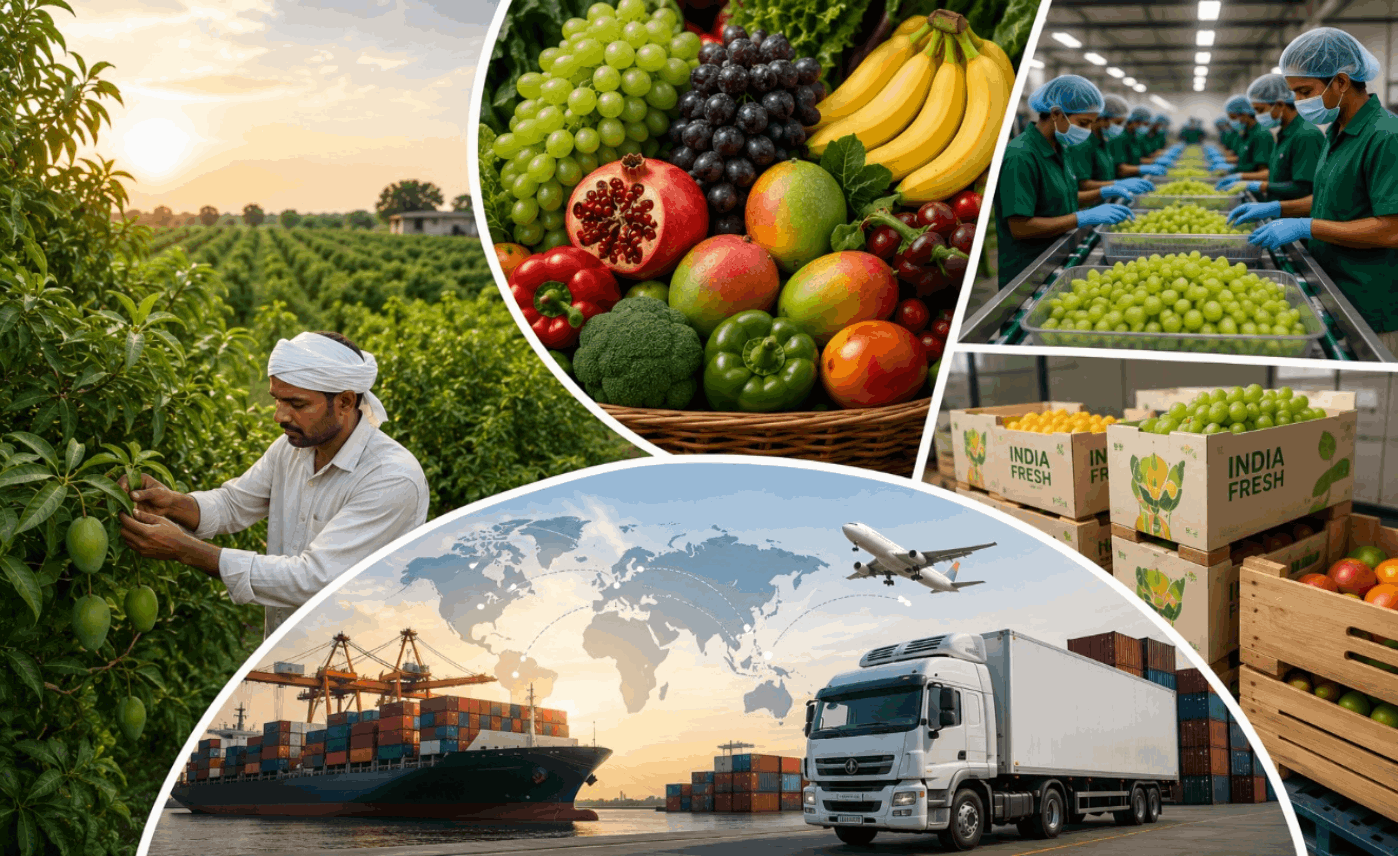
The food and beverage sector is one of the essential components of the FMCG market, which accounts for about 3% of its GDP. Agricultural and processed food exports touched Rs. 4,271.62 billion (US$ 49.4 billion) in 2024–25, with processed food accounting for 20.4% of the share, up from 13.7% in 2014-15.
India's FMCG sector continued to witness resilient household consumption in FY26, supported by strong rural demand and steady urban recovery. Rural FMCG volume sales grew by 8.4% in Q1 FY26, outperforming urban markets, where volume sales increased by 4.6%. According to CRISIL Ratings, organised FMCG companies are estimated to have generated around Rs. 6.6 lakh crore (US$ 74.69 billion) in revenue in FY26. The sector recorded healthy growth driven by pricing actions, while food & beverages accounted for nearly half of the industry's revenue. Consumer spending on ITC's FMCG portfolio increased by 8.8% to over Rs. 37,000 crore (US$ 4.19 billion) in FY26, with its brands reaching nearly 280 million households across India.
Household FMCG spending in India rose 8% to Rs. 17,792 crore (US$ 2.07 billion) by April 2025 and is expected to increase further to around Rs. 20,000 crore (US$ 2.27 billion) by the end of 2025, driven by higher consumption across staples as well as non-staples. The covid-19 pandemic has driven Indian consumers to focus their spending priorities on healthcare. FMCG household consumption across Indian cities exhibited a clear shift toward metro-driven concentration rather than uniform city-wise distribution, with e-commerce accounting for approximately 14% of FMCG sales across metros and increasing further to nearly 18% in the top 8 cities, significantly higher than the ~6% urban average. Notably, southern metro clusters emerged as the most digitally advanced consumption hubs, crossing ~21% e-commerce penetration, underscoring a strong shift toward online-led household purchasing behaviour in select urban pockets, even as overall urban FMCG growth remained relatively moderate in the range of ~2.3% to 4.6%, reflecting a structurally uneven but increasingly digital-first consumption landscape across India’s cities.
In 2025, rural India overtook cities in affordable premium FMCG consumption with a 51% volume share and contributed 42% of super-premium sales, as average rural premium spend grew at 11% CAGR over five years, driving a Rs. 98,000 crore (US$ 11.38 billion) market. Dabur generates 45-50% of its revenue from rural India, reaching over 1,31,000 villages and 1.42 million outlets. Hindustan Unilever earns 35-40% of its revenue from rural areas and leverages its Shikhar app, used by 1.4 million retailers with a 70% monthly active user rate, to expand rural reach.
India’s e-commerce industry, valued at Rs. 10,82,875 crore (US$ 125 billion) in FY24, is projected to grow to Rs. 29,88,735 crore (US$ 345 billion) by FY30, reflecting a CAGR of 18.4%.
As per CRISIL, India's dairy industry is projected to experience a healthy revenue growth of 13-14% in FY25, driven by strong consumer demand and increased raw milk supply.
India’s Rs. 46,571 crore (US$ 5.29 billion) snack market is seeing startup challenges to legacy brands and is set to reach Rs. 1,01,811 crore (US$ 11.57 billion) by 2033, with namkeen adding Rs. 39,591 crore (US$ 4.5 billion) by 2029.
India’s healthy snack market was valued at Rs. 27,065 crore (US$ 3.13 billion) in 2025, and it is expected to reach Rs. 45,634 crore (US$ 4.77 billion) by 2034, exhibiting a CAGR of 4.80%, driven by functional, natural options, quick commerce, and premiumisation. The market has grown exponentially over the past five years due to the surge in internet and smartphone users, improved policy reforms, and an increase in disposable income. Mobile wallets, Internet banking, and debit/credit cards have become popular among customers for making transactions on e-commerce platforms. The total internet subscribers in the country reached 1,092.79 million (1.09 billion) at the end of March 2026. This marks a significant 6.24% jump from the 1,028.61 million subscribers recorded in December 2025, underscoring rapidly expanding connectivity across both urban and rural regions. The total value of digital transactions stood at Rs. 21,960 billion (US$ 300 billion) in 2021 and is projected to reach Rs. 88,370 billion (US$ 1 trillion) by 2026. The India online grocery market size was projected to grow from Rs. 337.86 billion (US$ 4,540 million) in 2022 to Rs. 7.34 trillion (US$ 76,761.0 million) by 2032, at a CAGR of 32.7% through 2032. India’s beauty and personal care market, presently valued at Rs. 1607.37 billion (US$ 16.8 billion), is poised to grow at a compound annual rate of 11%, with cosmetics and perfumes categories growing at a faster clip.
The outlook of the FMCG sector looks on track with the pandemic easing out. Rural consumption has increased, led by a combination of increasing income and higher aspiration levels. There is an increased demand for branded products in rural India. On the other hand, with the share of the unorganised market in the FMCG sector falling, the organised sector growth is expected to rise with an increased level of brand consciousness, augmented by the growth in modern retail.