Introduction
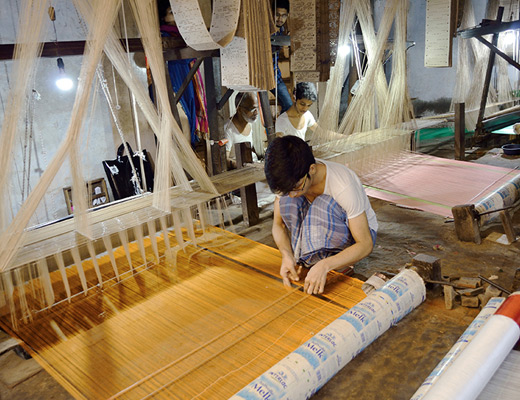
Silk holds a distinctive place in India’s cultural and economic landscape, deeply interwoven with the country’s heritage, craftsmanship, and textile traditions. Renowned as the “Queen of Textiles”, silk is valued for its natural sheen, vibrant colours, fine texture, and elegant drape, making it one of the most premium textile fibres globally. India is one of the largest consumers of silk, supported by a strong domestic market rooted in traditional attire such as sarees, stoles, dress materials, and ready-made garments. The country’s silk weaving legacy is reflected in iconic regional clusters such as Kanchipuram, Varanasi, Bhagalpur, Sualkuchi, and Srinagar, each known for distinct weaving styles and craftsmanship. India remains the second-largest producer of silk in the world, with the country's sericulture industry employing around 9.84 million people in rural and semi-urban areas as of FY26, up from 9.73 million in FY25. The industry continues to be one of the largest foreign exchange earners in the country, with sericulture activities spread across 52,500 villages. India produces four types of natural silk, Mulberry, Eri, Tasar and Muga, which are converted into silk garments, made-ups, fabrics, yarns, carpets, shawls, scarves, cushion covers and accessories.
Share of silk type in India’s total silk production (FY26)

Source: Central Silk Board of India, Ministry of Textiles
India's raw silk production has demonstrated a steady upward trajectory over the past five years, supported by expansion in mulberry cultivation and sustained growth in both bivoltine and multivoltine silk output. The area under mulberry plantation increased from 237,578 hectares in 2020-21 to 269,670 hectares in 2025-26, reflecting continued capacity expansion in the sericulture sector. Correspondingly, total raw silk production rose from 33,770 MT in 2020-21 to 41,121 MT in 2024-25, before reaching 42,033 MT in 2025-26.
Within the production mix, mulberry silk remained the dominant segment, with output increasing from 23,896 MT in 2020-21 to 32,250 MT in 2025-26, driven by strong growth in both bivoltine (11,229 MT) and multivoltine (21,021 MT) varieties. Vanya silk production, including tasar, eri, and muga silk, also rose to 9,783 MT in 2025-26 from 10,002 MT in 2024-25, underlining India's continued strength in niche and traditional silk varieties. The sustained rise in production highlights the resilience of India's sericulture ecosystem and its importance in supporting rural livelihoods and textile value chains.
India’s silk production trend (MT)

Source: Central Silk Board of India, Ministry of Textiles
Export Trend
India’s silk and silk products export trend (US$ million)

Source: The Indian Silk Export Promotion Council (ISEPC), Ministry of Commerce and Industry
India's silk exports during April-June 2026 were led by natural silk yarn, fabrics and made-ups, valued at Rs. 432.83 crore (US$ 51.23 million), reflecting continued strength in value-added silk textile categories. Ready-made garments of silk followed at Rs. 194.05 crore (US$ 22.97 million), underlining sustained demand for finished silk apparel in export markets, while silk carpets contributed Rs. 101.55 crore (US$ 12.02 million) on a volume of 69,923 sqm.
Silk waste exports stood at Rs. 84.81 crore (US$ 10.04 million) on a volume of 9.46 lakh kgs, while raw silk exports remained modest at Rs. 1.78 crore (US$ 0.21 million) on 9,280 kgs, reflecting India's continued dependence on raw silk imports to support domestic processing capacity. Overall, the export mix during the quarter highlights the dominance of processed and value-added silk products over raw silk in India's export basket.
Export Destinations
The USA was the largest destination for India's silk exports during April-June 2026, accounting for a 55.79% share worth US$ 53.81 million, driven primarily by natural silk yarn, fabrics and made-ups. China followed at 10.47% (US$ 10.09 million), largely on account of silk waste exports, while Malaysia (4.03%; US$ 3.89 million) and the UK (3.05%; US$ 2.95 million) rounded out the other major markets, together with France (2.08%; US$ 2.00 million).
The UAE (1.93%; US$ 1.86 million), Afghanistan (1.92%; US$ 1.85 million) and Uzbekistan (1.82%; US$ 1.76 million) were also notable destinations, alongside Germany (1.48%; US$ 1.43 million), Italy (1.64%; US$ 1.58 million), Canada (1.09%; US$ 1.05 million) and Nepal (1.33%; US$ 1.29 million). Overall, India's silk exports during the quarter reached US$ 96.46 million, reflecting a geographically diversified basket spanning North America, Asia, Europe and West Asia, with the USA and China together accounting for over 66% of total exports.
Country-wise share of India’s silk exports during FY27 (Till June 2026)

Source: Department of Commerce
Government Initiatives
For the development and growth of the silk industry in India, the government has implemented several research & development, training, transfer of technology and IT initiatives. The focus is to develop new technologies, train a larger workforce, provide education, and enhance connectivity between scientists, experts, and developers. In addition to these, there are various schemes such as the Tribal Sub-Plan (TSP) and Silk Samagra and Scheduled Caste Sub-Plan (SCSP) are implemented for the development of the industry.
Silk Samagra
Silk Samagra was an Integrated Scheme for Development of Silk Industry (ISDSI) which the Government of India introduced through the Central Silk Board (CSB). This scheme had a total outlay of Rs. 2,161.68 crore (US$ 272.8 million) for 3 years (2017-18 to 2019-20) and was aimed at the complete development of the silk industry in India. This scheme will aid in silk production by improving quality and productivity.
Sericulture Development in the North-Eastern States (NERTPS)
The Government of India had launched the sericulture development scheme within an umbrella scheme, namely “North-East Region Textile Promotion scheme”. The objective of this scheme was the revival, expansion, and diversification of sericulture in the state with a special focus on Eri and Muga silks.
Governing Body
The Indian Silk Export Promotion Council (ISEPC)
Sponsored by the Ministry of Textiles, Government of India, the ISEPC is an apex body of the exporters, manufacturers and merchandisers. The main activities of the council are to explore markets, establish contacts with potential buyers, organize buyer-seller meets, silk fairs, and exhibitions, resolve trade disputes, and promote and develop the Indian silk industry and exports.
FAQs
Natural silk yarn, fabrics and made-ups lead India's silk exports at US$ 51.23 million, followed by ready-made garments of silk at US$ 22.97 million. Silk carpets and silk waste also contribute meaningfully to the silk industry's overall export earnings.
India's silk exports grew from US$ 261.1 million in FY22 to US$ 388.3 million in FY26, reflecting steady expansion of the silk export market. During April-June 2026 alone, silk exports reached US$ 96.46 million, underlining continued global demand for Indian silk products.
The Central Silk Board drives the development of India's silk industry through research, technology transfer and training initiatives, including schemes like Silk Samagra. While the Indian Silk Export Promotion Council (ISEPC) handles export promotion, the Central Silk Board strengthens production quality and productivity, supporting the broader silk export ecosystem.
Mulberry silk remains the dominant variety in mulberry silk production, accounting for the largest share of India's total silk output in FY26. Vanya silk varieties, including tasar, eri and muga, also contribute to India's diverse silk industry export basket.
Sericulture in India spans 52,500 villages, employing around 9.84 million people in rural and semi-urban areas as of FY26. Iconic weaving clusters such as Kanchipuram, Varanasi, Bhagalpur, Sualkuchi and Srinagar continue to strengthen the silk industry's craftsmanship legacy.
India's silk weaving legacy is anchored in regional hubs known for mulberry silk production and traditional craftsmanship, including Kanchipuram, Varanasi, Bhagalpur, Sualkuchi and Srinagar. These clusters collectively support India's position as the world's second-largest silk producer.
Value-added categories like natural silk yarn, fabrics, made-ups and ready-made garments dominate India's silk export basket, together far outpacing raw silk exports. This shift towards processed silk products is enhancing India's competitiveness in the global silk export market.
The USA and China together account for over 66% of India's silk exports, driven by demand for natural silk yarn, fabrics and silk waste respectively. Continued diversification into markets like Malaysia, the UK, France and the UAE is further expanding opportunities for the silk industry.
Traditional weaving techniques from clusters like Kanchipuram and Varanasi continue to underpin India's silk export appeal, blending heritage craftsmanship with premium textile quality. This legacy supports sustained demand for Indian silk products, including sarees, stoles and ready-made garments, in international markets.
India's silk industry outlook remains positive, supported by rising mulberry silk production, growing employment in sericulture, and sustained government initiatives like Silk Samagra. Continued focus on value-added silk products and export diversification is expected to further strengthen the silk export market.
RELATED SITES

62, Mittal Chambers
Nariman Point
Mumbai - 400021
Maharashtra
India
Tel.:+91-22-22025866/22027662
Fax: +91-22-22874606
Email: isepc@bom2.vsnl.net.in
Website: http://www.theindiansilkexportpromotioncouncil.com/
Partners