|
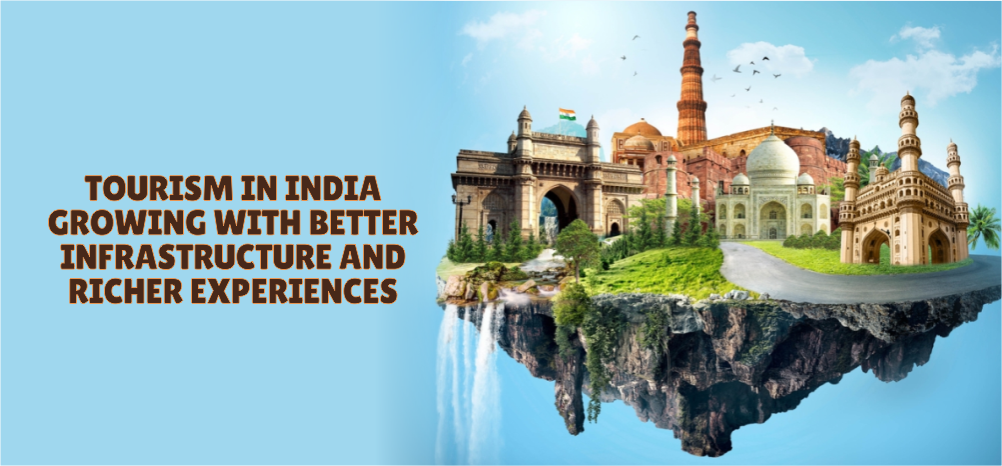
India offers myriad exciting experiences to tourists. Tourism industry in India is being utilised as a powerful tool to facilitate international understanding and enable building of broader cultural horizons. According to the Travel & Tourism Competitiveness Report 2009 brought out by World Economic Forum, India is ranked 11th in the Asia-Pacific region and 62nd overall in a list of 133 assessed countries in 2008, up three places since 2007. In terms of travel, India stands 9th in the index of relative cost of access (ticket taxes and airport charges) to international air transport services, having almost the lowest costs in the world.
Also according to the report, India has been rated well for its natural resources (ranked 14th) and cultural resources (24th), with many World Heritage sites, both natural and cultural, rich fauna, and strong creative industries in the country. India also has quite a good air transport network (ranked 37th), particularly given the country’s stage of development, and a reasonable ground transport infrastructure (ranked 49th). India is ranked 7th in terms of number of World Heritage cultural sites, according to a UNESCO report (2008).
India is ranked 1st with regard to tourism fair attendance. Also, according to the International Congress and Convention Association, India is rated 33rd in terms of number of international fairs and exhibitions held in the country annually (average for 2006-07).
The World Travel and Tourism Report for 2009 for 180 countries worldwide also ranks the Indian Travel and Tourism economy 14th in absolute size worldwide, 144th in relative contribution to national economies and 5th in long-term (10-year) growth. The contribution of travel and tourism to gross domestic product (GDP) is expected to be at 6.0 per cent (US$ 67.3 billion) in 2009 rising to US$ 187.3 billion by 2019.
The report also states that real GDP growth for travel and tourism economy is expected to be 0.2 per cent in 2009 and to an average 7.7 per cent per annum over the coming 10 years. Export earnings from international visitors and tourism goods are expected to generate 6.0 per cent of total exports (almost US$ 16.9 billion) in 2009, growing (nominal terms) to US$ 51.4 billion in 2019.
Growth Trends
According to the Ministry of Tourism, Foreign Tourist Arrivals (FTAs) during the month of March 2009 were 472,000 and the decline in FTAs may be mainly due to ongoing global financial meltdown. FTAs during January to March 2009 were at 1.461 million.
Foreign Exchange Earning (FEE) during the month of March 2009 was US$ 867 million while FEE during January to March 2009 was US$ 2731 million. The lower growth rate in March 2009 as compared to March 2008 is mainly due to exchange rate variation and lower growth rate of FTAs.
Despite short- and medium-term setbacks, tourism revenues are expected to rise by 42 per cent from 2007 to 2017. Every year, more than 3 million tourists visit the Taj Mahal in Agra. According to figures released by Kerala Tourism, a little over 7.591 million domestic tourists visited the State in 2008, which was a growth of 14.28 per cent compared to 2007. Foreign tourist arrivals also grew—by a healthy 16.11 per cent—in 2008, with just over 598,000 foreigners visiting Kerala.
Medical Tourism
A number of reasonably priced wellness centres such as 20 by Facet Lifestyle and health spas are coming up in several destinations increasing patient arrivals.
The country ranks second in medical tourism. In 2007, Indian hospitals treated 450,000 patients from other countries against topper Thailand's 1.2 million. A two-year study by healthcare researchers Deloitte revealed that there's a significant rise in patients in India from the US, UK and Europe apart from the usual inflow of patients from neighbouring countries and West Asia.
Healthcare majors in the eastern region too are wooing international patients with special offerings. Leading players in the field, like the Calcutta Medical Research institute (CMRI), Medica Synergy Limited (MSL), Apollo Gleneagles, BM Birla Heart Research Centre, are offering added facilities to these patients. Apollo is expecting an increase of about 30 to 40 per cent in international patients this year, mostly from the UK, US, Italy and Germany.
Hospitality Sector
The hospitality sector is expected to rise to US$ 275 billion in the next 10 years. The domestic hospitality sector is expected to see investments of over US$ 11 billion in the next two years within 40 international hotel brands making their presence in the country in the next few years.
At the Vibrant Gujarat Global Investors' Summit, memorandums of understanding ( MoUs) worth US$ 9.10 billion for hotels, convention centres, resorts, and adventure tourism in the state, were signed.
Government Initiatives
According to the Tourism Secretary, Mr Sujit Banerjee, the government is offering attractive packages to foreign tourists and has organised road shows in major markets such as the UK, Canada, Australia, Singapore and Malaysia.
- The ministry is offering free air ticket for companion, travel to additional places and extended stay at hotels.
- Now, foreign medical tourists will be offered one additional treatment for free. Apollo, Manipal, Moolchand, Fortis and Wockhardt among others have forwarded their proposals for the same.
- The government has also taken a number of steps to minimise the impact of the slowdown. This year has been designated as the ‘Visit India’ year. The ministry has increased financial support to tour operators for promoting India in international exhibitions. To involve more operators, the ministry has doubled the upper ceiling of foreign exchange earnings of applicant companies to US$ 4.05 million under the market development assistance scheme.
- All issues including uniform state-level tax structure, luxury tax and free-movement of inter-state tourist vehicles are being reviewed by the empowered committee of state finance ministers.
- To strengthen the Indian tourism sector ahead of the Commonwealth Games in 2010 and to double foreign tourist arrivals from 5.37 million in 2008 to 10 million by 2010, the ministry is taking measures such as rationalising taxes, increased focus on infrastructure and easy visas.
|