Advantage India
Robust
Demand
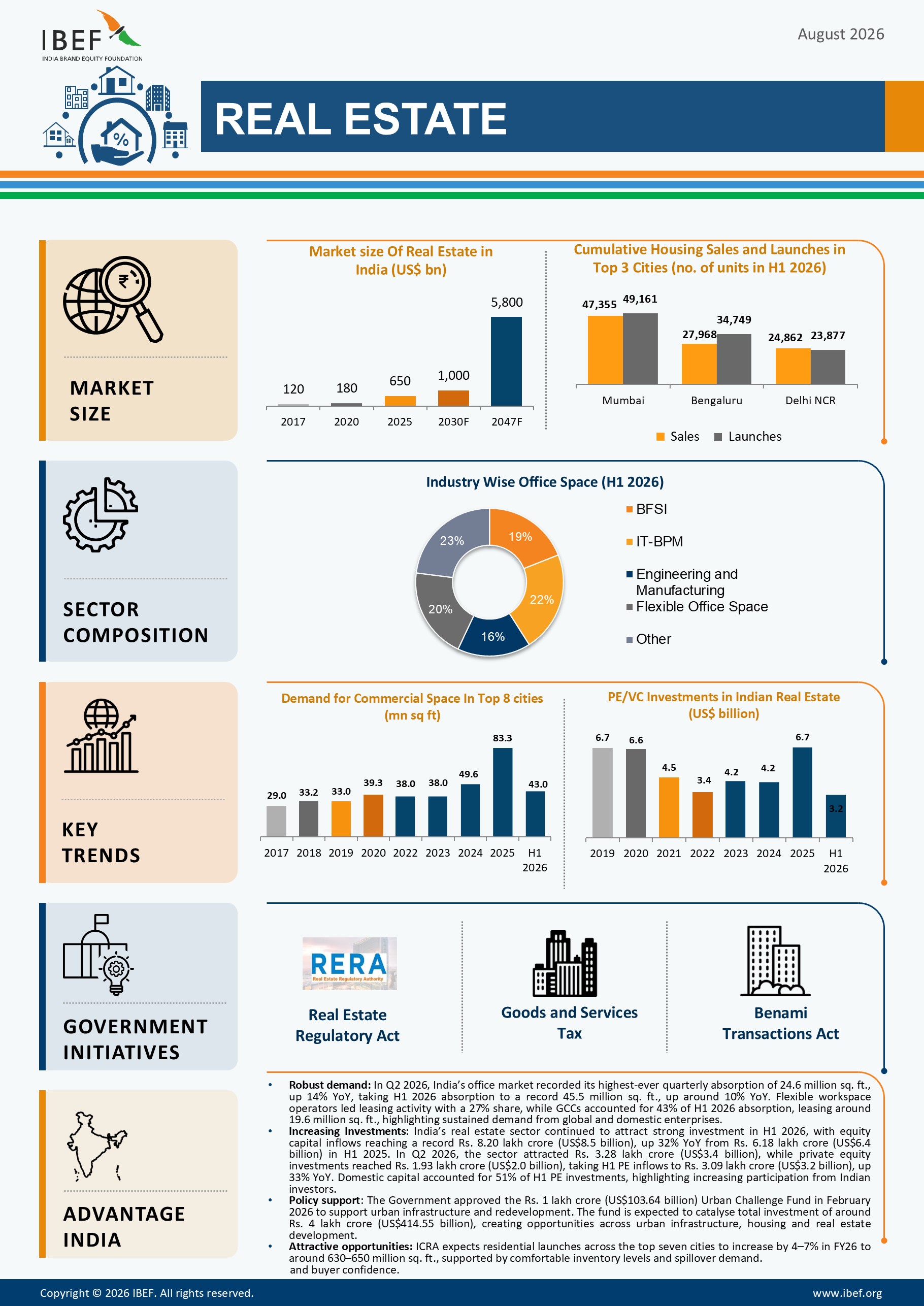
*Robust demand and rising investments continued to support India’s real estate sector, with record office absorption of 45.5 million sq. ft. and equity capital inflows of US$8.5 billion in H1 2026.
*In Q2 2026, India’s office market recorded its highest-ever quarterly absorption of 24.6 million sq. ft., up 14% YoY, taking H1 2026 absorption to a record 45.5 million sq. ft., up around 10% YoY. Flexible workspace operators led leasing activity with a 27% share, while GCCs accounted for 43% of H1 2026 absorption, leasing around 19.6 million sq. ft., highlighting sustained demand from global and domestic enterprises.
*In December 2025, the Reserve Bank of India (RBI) reduced the repo rate by 25 basis points to 5.25%, improving home loan affordability and supporting residential demand.

Attractive
Opportunities
*ICRA expects residential launches across the top seven cities to increase by 4–7% in FY26 to around 630–650 million sq. ft., supported by comfortable inventory levels and spillover demand.
*Residential property prices increased across all eight major Indian cities during Q1 2026, recording annual growth of 3%–24%, led by Bengaluru (24%), followed by the National Capital Region (20%) and Hyderabad (11%), reflecting sustained housing demand and improving market fundamentals.
*Private market investor, Blackstone, which has significantly invested in the Indian real estate sector worth Rs. 3.8 lakh crore (US$ 50 billion), is seeking to invest an additional Rs. 1.7 lakh crore (US$ 22 billion) by 2030.

Policy
Support
*The RBI has maintained the policy repo rate at 5.25%, supporting a stable interest-rate environment for homebuyers and developers.
*The Union Budget 2026-27 emphasises infrastructure-led growth, with public capital expenditure increased in FY27 (2026–27) to Rs. 12.20 lakh crore (US$ 138.03 billion) from Rs. 11.20 lakh crore (US$ 126.73 billion) in FY26 (2025–26).
*The Government approved the Rs. 1 lakh crore (US$103.64 billion) Urban Challenge Fund in February 2026 to support urban infrastructure and redevelopment. The fund is expected to catalyse total investment of around Rs. 4 lakh crore (US$414.55 billion), creating opportunities across urban infrastructure, housing and real estate development.

Increasing
Investments
*As of October 2025, institutional investments of Rs. 36,348 crore (US$ 4.30 billion), coupled with increasing adoption of Real Estate Investment Trusts (REITs).
*India’s real estate sector continued to attract strong investment in H1 2026, with equity capital inflows reaching a record Rs. 8.20 lakh crore (US$8.5 billion), up 32% YoY from Rs. 6.18 lakh crore (US$6.4 billion) in H1 2025. In Q2 2026, the sector attracted Rs. 3.28 lakh crore (US$3.4 billion), while private equity investments reached Rs. 1.93 lakh crore (US$2.0 billion), taking H1 PE inflows to Rs. 3.09 lakh crore (US$3.2 billion), up 33% YoY. Domestic capital accounted for 51% of H1 PE investments, highlighting increasing participation from Indian investors.
*Private equity (PE) and venture capital (VC) investments totalled Rs. 455.73 lakh crore (US$ 49.30 billion) in the first 11 months of 2025, accounting for about 88.00% of the Rs. 519.93 lakh crore (US$ 56.20 billion) deployed in 2024, highlighting sustained investor momentum and faster capital deployment cycles, according to Anarock capital.


Related News
MOREReal Estate Clusters
- Mumbai
- NCR
- Bengaluru
- Pune
- Chennai
- Hyderabad

Posters
MORE
Real Estate Companies in India
India is the leading real estate investment market in Asia. Construction margins in India are also double that of the world average - a perfect combination that makes India the most profitable construction market in the world.
IBEF Campaigns
MORE

Case Studies
MOREHow Indian Pharmaceutical Companies Are Strengthening Their Position in Global Markets

India has become a key player in the pharmaceutical industry of the world, which can be described in terms of the following factors: large-scale manuf...
Containerisation: Transforming India's Maritime Trade

Despite other modes of transportation, the maritime shipping mode is the backbone of international trade. The concept of containerisation has revoluti...
India’s Growing Senior Care Needs: New Businesses and Services

The current state of India is characterised by the process of demographic transition with gradual growth of the proportion of senior citizens within t...
IBEF BLOG
MORE
India's Deep-Tech Startup Wave: Beyond Fintech and E-commerce
The Indian start-up eco-system, traditionally known for its focus on digita...

Investment Opportunities in India: Sectors With Strong Growth Potential
India has emerged as a potential investment destination owing to its econom...

Why Smaller Indian Cities Are Becoming New Destinations for Property Development
The Indian property development landscape is witnessing a broadening of opp...
Partners