|
Sector/Market Size
The US$ 18 billion Indian Railways industry has one of the largest developed networks in the world. The premier transport and logistics organisation of the country is also the largest rail network in Asia and the world’s second largest under single management. It runs through the country covering 63,140 route km, carrying 20 million passengers a day on about 18,000 trains. It employs 1.4 million people. It is one of the few mixed traffic systems in the world, carrying both passengers and freight that generates a cash surplus.
The Indian Railways is the backbone of the Indian transport system. Its freight business is a good reflection of the recovery of the Indian economy. The Railways moved 72.76 million tonnes (mt) of revenue earning freight in November 2009, registering 9.22 per cent growth over November 2007. The growth was driven by steel, coal, fertiliser and iron ore. This figure had increased by just 1.29 per cent between November 2007 and November 2008.
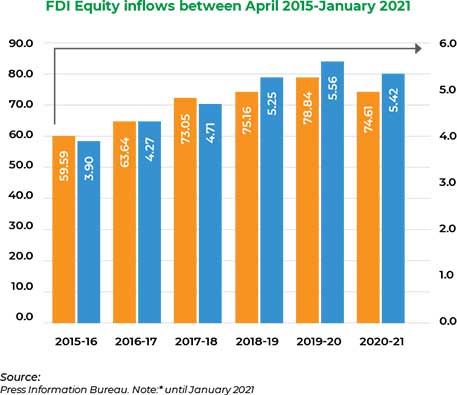
According to the Department of Industrial Policy and Promotion (DIPP), the foreign direct investment (FDI) inflow into railways related components has been US$ 77.49 million from April 2000 to September 2009. A quarterly estimate for Q2, 2009-10 for railways by the Central Statistical Organisation suggests growth rates at 11.2 per cent and 6.3 per cent for net tonne km and passenger km, respectively.
The traffic between Delhi, Mumbai, Kolkata and Chennai is the heaviest, though the total area used by them is just 16 per cent of the entire Indian Railways network in the country.
In the Union Railway Budget for 2009-10, presented on July 3, 2009, the Railways Minister highlighted the following:
- Plan outlay of US$ 8.34 billion proposed for 2009-10.
- Passenger amenities get high priority, to get US$ 225.63 million.
- Freight loading at 833 million tonnes (MT) grew at 5 per cent over the previous year.
- Traffic receipts during 2008-09 increased by 11.4 per cent to touch US$ 16.34 billion.
- Railways paid full dividend liability of US$ 965.14 million to the government.
- Investible surplus of US$ 2.6 billion generated.
- 'Only ladies' EMU trains to start in Delhi, Chennai and Kolkata.
- 'Yuva trains' from rural hinterland to metros at concessional fare.
- 12 new point-to-point non-stop 'Duronto' trains.
- 57 new trains, extension of 27 trains and increase in frequency of 13 trains proposed.
- 50 stations to be developed as world-class stations.
- Creation of Northeast Rail Development Fund under consideration for timely completion of national projects in Northeast Region.
- Railways to come out with white paper on organisational, operational and financial status based on the last five years performance and develop Vision-2020 document.
Growth Trend
Indian Railways' revenue earnings have increasing by 8.74 per cent to an estimated US$ 11.97 billion during April-November 2009, compared with US$ 10.29 billion during the same period last year.
Total earnings from goods traffic went up by 8.56 per cent to US$ 8.04 billion during April-November 2009 from US$ 6.92 billion during April-November 2008.
During this period, the Railways carried 574.38 million tonnes of revenue freight traffic, registering an increase of 7.44 per cent over the 534.6 million tonnes carried during the corresponding period last year.
During the first eight months of the financial year 2009-10, total passenger revenue earnings increased by 8.01 per cent to US$ 3.36 billion from US$ 2.91 billion during the same period last year.
The total approximate number of passengers booked during April-November 2009 increased by 4.67 per cent to 4.94 billion from 4.72 billion during the same period last year. In the suburban and non-suburban sectors, the numbers of passengers booked during April-November 2009 were 2.54 billion and 2. 34 billion, compared with 2.51 billion and 2.2 billion during the same period last year.
Revenue earnings from other sources increased 15.71 per cent to US$ 323.25 million during April-November 2009 from US$ 261.11 million, during the same period last year.
|